Now that we have a definition for continuity at a number, we can go ahead and define what we mean when we say a function is continuous over an interval.
The function \(f\) is continuous over a closed interval \(\cinterval{a}{b}\) if and only if it is continuous on \(\ointerval{a}{b}\text{,}\) continuous from the right at \(a\text{,}\) and continuous from the left at \(b\text{.}\) Similar definitions apply to half-open intervals.
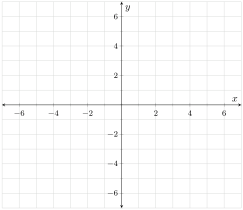
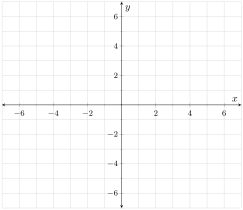
Several functions are described below. Your task is to sketch a graph for each function on its provided axis system. Do not introduce any unnecessary discontinuities or intercepts that are not directly implied by the stated properties. Make sure that you draw all implied asymptotes and label them with their equations.
\begin{align*}
\fe{f}{0}=4\text{ and }\fe{f}{4}&=5\\
\lim_{x\to4^{-}}\fe{f}{x}=2\text{ and }\lim_{x\to4^{+}}\fe{f}{x}&=5\\
\lim_{x\to-\infty}\fe{f}{x}=\lim_{x\to\infty}\fe{f}{x}&=4
\end{align*}
\(m\) only has discontinuities at \(-4\) and \(3\text{.}\)\(m\) has no zeros. \(m\) has slope \(-2\) over \(\ointerval{-\infty}{-4}\text{.}\)\(m\) is continuous over \(\cointerval{-4}{3}\text{.}\)