Worksheet Worksheet
The table below defines the functions \(f\text{,}\) \(g\text{,}\) \(h\text{,}\) \(k\text{,}\) and \(l\text{.}\)
| \(x\) | \(-2\) | \(-1\) | \(0\) | \(1\) | \(2\) |
| \(f(x)\) | \(0\) | \(1\) | \(2\) | \(3\) | \(4\) |
| \(g(x)\) | \(4\) | \(3\) | \(2\) | \(1\) | \(0\) |
| \(h(x)\) | \(0\) | \(-1\) | \(-2\) | \(-3\) | \(-4\) |
| \(k(x)\) | \(6\) | \(7\) | \(8\) | \(9\) | \(10\) |
| \(l(x)\) | \(0\) | \(3\) | \(6\) | \(9\) | \(12\) |
1.
Express \(g(x)\) in terms of \(f\) and describe how the graph of \(y=f(x)\) can be transformed into the graph of \(y=g(x)\text{.}\)
2.
Express \(h(x)\) in terms of \(f\) and describe how the graph of \(y=f(x)\) can be transformed into the graph of \(y=h(x)\text{.}\)
3.
Express \(k(x)\) in terms of \(f\) and describe how the graph of \(y=f(x)\) can be transformed into the graph of \(y=k(x)\text{.}\)
4.
Express \(l(x)\) in terms of \(f\) and describe how the graph of \(y=f(x)\) can be transformed into the graph of \(y=l(x)\text{.}\)
5.
The second row in the table below gives values for the function, \(f\text{.}\) Complete the rest of the table. If you don't have sufficient information to fill in some of the cells, leave those cells blank.
| \(x\) | \(-4\) | \(-3\) | \(-2\) | \(-1\) | \(0\) | \(1\) | \(2\) | \(3\) | \(4\) |
| \(f(x)\) | \(-2\) | \(-1\) | \(0\) | \(1\) | \(2\) | \(3\) | \(4\) | \(5\) | \(6\) |
| \(\frac{1}{2}x\) | |||||||||
| \(-2f(x)\) | |||||||||
| \(f(x)+5\) | |||||||||
| \(f(x+2)\) | |||||||||
| \(f\left( \frac{1}{2}x \right)\) | |||||||||
| \(f(2x)\) | |||||||||
| \(f(x-3)\) | \(\phantom{-0}\) | \(\phantom{-0}\) | \(\phantom{-0}\) | \(\phantom{-0}\) | \(\phantom{-0}\) | \(\phantom{-0}\) | \(\phantom{-0}\) | \(\phantom{-0}\) | \(\phantom{-0}\) |
First write \(g(x)\) in terms of \(f\text{.}\) Then compose a sequence of transformations that will transform the graph of \(y=f(x)\) into the graph of \(y=g(x)\text{.}\)
6.
\(f(x)=\sqrt{x}\qquad g(x)=\frac{\sqrt{x-7}}{4}\)
7.
\(f(x)=\frac{1}{x}\qquad g(x)=\frac{2}{x}+3\)
8.
\(f(x)=x^2\qquad g(x)=-4\left( \frac{1}{2}x-5 \right)^2+3\)
9.
\([t]f(x)=\sqrt[3]{x}\qquad g(x)=\frac{1}{2}\sqrt[3]{10x+30}-6\)
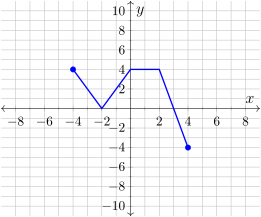
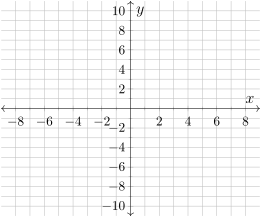
Use the graph of \(y=f(x)\) that is provided to sketch a graph of each given function.
10.
\(k_1(x)=f(2x)\)
11.
\(k_2(x)=2f(-2x)-1\)
12.
\(k_3(x)=-2f(2x+4)\)
13.
\(k_4(x)=f\left(\frac{1}{2}x\right) +2\)