Section 2.1 Angles
Watermark text: DRAFT
Subsection 2.1.1 Coterminal Angles
Definition 2.1.1.
Two angles are coterminal if they have the same terminal side when in standard position.
Since \(360^{\circ}\) represents a complete revolution, if we add integer-multiples of \(360^{\circ}\) to an angle measured in degrees, we'll obtain a coterminal angle. Similarly, since \(2\pi\) represents a complete revolution in radians, if we add integer-multiples of \(2\pi\) to an angle measured in radians, we'll obtain a coterminal angle. We can summarize this information as follows
If \(\theta\) is measured in degrees, \(\theta\) and \(\theta + 360^{\circ} \cdot k\text{,}\) where \(k\in\mathbb{Z}\text{,}\) are coterminal.
If \(\theta\) is measured in radians, \(\theta\) and \(\theta + 2\pi \cdot k\text{,}\) where \(k\in\mathbb{Z}\text{,}\) are coterminal.
Example 2.1.2.
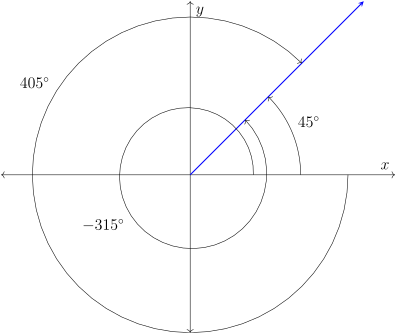
The angles \(45^{\circ}\text{,}\) \(405^{\circ}\text{,}\) and \(315^{\circ}\) are coterminal as illustrated in Figure 2.1.3.
Subsection 2.1.2 Reference Angles
Definition 2.1.4.
The reference angle for an angle in standard position is the positive acute angle formed by the \(x\)-axis and the terminal side of the angle.
Depending on the location of the angle's terminal side, we'll have to use a different calculation to determine the angle's reference angle.
Example 2.1.5.
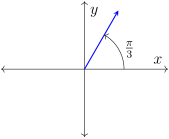
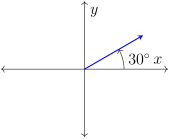
The angles \(\frac{\pi}{3}\) and \(30^{\circ}\) are their own reference angles since they are acute angles; seen in Figure 2.1.6 and Figure 2.1.7.
Example 2.1.8.
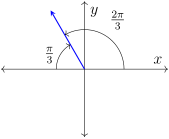
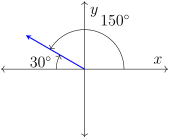
The reference angle for \(\frac{2\pi}{3}\) is \(\pi-\frac{2\pi}{3}=\frac{\pi}{3}\) (see Figure 2.1.9), while the reference angle for \(150^{\circ}\) is \(180^{\circ}-150^{\circ}=30^{\circ}\) (see Figure 2.1.10).
Example 2.1.11.
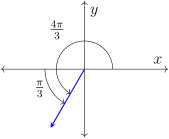
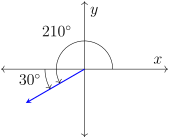
The reference angle for \(\frac{4\pi}{3}\) is \(\frac{4\pi}{3}-\pi=\frac{\pi}{3}\) (see Figure 2.1.12), while the reference angle for \(210^{\circ}\) is \(210^{\circ}-180^{\circ}=30^{\circ}\) (see Figure 2.1.13).
Example 2.1.14.
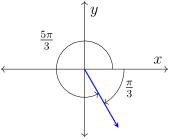
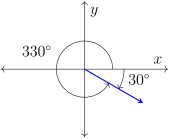
The reference angle for \(\frac{5\pi}{3}\) is \(2\pi-\frac{5\pi}{3}=\frac{\pi}{3}\) (see Figure 2.1.15), while the reference angle for \(330^{\circ}\) is \(360^{\circ}-330^{\circ}=30^{\circ}\) (see Figure 2.1.16).
Example 2.1.17.
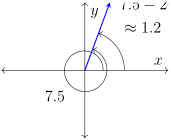
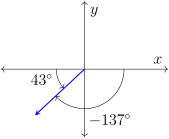
The reference angle for \(7.5\) radians is \(7.5-2\pi\approx 1.2\) radians (see Figure 2.1.18), and the reference angle for \(-137^{\circ}\) is \(180^{\circ}+( \, 137^{\circ} ) \,=43^{\circ}\) (see Figure 2.1.19).
Exercises 2.1.3 Exercises
Find both a positive and negative angle that is coterminal angle with the following angles.
1.
\(63^{\circ}\)
2.
\(\frac{\pi}{9}\)
3.
\(\frac{13\pi}{8}\)
Find the reference angle for the following angles.
4.
\(120^{\circ}\)
5.
\(\frac{5\pi}{4}\)
6.
\(400^{\circ}\)
7.
\(\frac{13\pi}{8}\)
8.
\(2\)
9.
\(\frac{10\pi}{11}\)
10.
\(2000^{\circ}\)
11.
\(-\frac{9\pi}{5}\)
12.
\(-100^{\circ}\)