Section 1.4 Logarithmic Functions
Watermark text: DRAFT
Example 1.4.1.
The graph of \(f(x)=\log_a(x)\) is given in the graph below. Find the value of \(a\text{.}\) Note, the points \(\left( 1,0 \right)\) and \(\left( 9,2 \right)\) are on the graph of \(f\text{.}\)
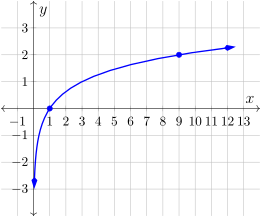
Since the function has the form \(f(x)=\log_a(x)\) and \(\left( 9,2 \right)\) is on the graph, we know that \(f(9)=2\text{.}\) Thus,
Notice that we didn't attempt to use \(\left( 1,0 \right)\text{,}\) the other obvious point on the graph of \(f(x)=\log_a(x)\text{,}\) to find the value of \(a\text{.}\) Why not? The point \(\left( 1,0 \right)\) is on the graph of all functions of the form \(f(x)=\log_a(x)\text{,}\) so it doesn't provide information that will help us find the paerticular function graphed here.
Exercises Exercises
1.
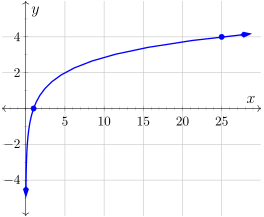
The graph of \(f(x)=\log_a(x)\) is given below. Find the value of \(a\text{.}\) Note, the points \(\left( 1,0 \right)\) and \(\left( 25,4 \right)\) are on the graph of \(f\text{.}\)
Each table represents a table-of-values for a function \(f(x)=\log_a(x)\text{.}\) Find the value of \(a\text{.}\)
2.
| \(x\) | \(0.000125\) | \(0.5\) | \(1\) | \(2\sqrt{5}\) | \(400\) |
| \(f(x)\) | \(-3\) | \(-1\) | \(0\) | \(0.5\) | \(2\) |
3.
| \(x\) | \(\frac{1}{9}\) | \(1\) | \(3\) | \(81\) | \(243\) |
| \(f(x)\) | \(-4\) | \(0\) | \(2\) | \(8\) | \(10\) |