 Course Lecture
LECTURE
OHM'S LAW AND POWER
IN THE ELECTRIC CIRCUITS.
THE INTERNATIONAL SYSTEM OF UNITS
- Measuring Current
The electric current (I) is measured in Amperes (A). The meter that measures the electric current in a circuit is cold ammeter. Always the ammeter is connected in series in a circuit, and the way in which one connects the two leads counts. The internal resistance of an ammeter should be very low.
- Measuring Voltage
The voltage of a source or the voltage drop across a resistor in a circuit is measured in Volts (V). The meter that measures the voltage is cold voltmeter. Always the voltmeter is connected in parallel with the component or with the voltage source across which the voltage should be measured. The way in which one connects the two leads counts. The internal resistance of a voltmeter should be very high.
- Measuring Resistance
The resistance of a resistor or of a combination of resistors is measured in Ohms (W). The meter that measures resistance is named ohmmeter. The ohmmeter should be connected in parallel with the resistor or the group of resistors but only after the power of the circuit is turned off. The position of the two leads does not count, since the resistance does not have polarity. Remember: do not measure resistance of a resistor that has a voltage applied across its terminals.
- Ohm's Law
This main law of electricity states that the current flowing through a resistor is directly proportional to the voltage across the resistor and inversely proportional to the resistance.
In equation form, that is:
V = I * R (V) = (A) * (Ω) - Power
Power is the rate of doing work, and is equal to the product of voltage and current. So we can say that a resistor R, having a voltage V across it and a current I flowing through it, will dissipate the power P equal to:
P = V * I =(V2)/(R)=(I2)*R (W) = (V)*(A)=(V2)/(Ω) = (A2)*(Ω) As you can see, the unit for power is Watt (W). The wattmeter is the meter that measures the power dissipated by an electric circuit.
- Energy
Energy is the capacity to do work. In an electric circuit, the source of voltage or current is the one that provides energy. In a resistive circuit, all the energy provided by the source is converted to heat (one form of energy).
The energy in an electric circuit is easily calculated when the power is known:
W (as in work or energy) = P * t
As you can see, the joule is the unit of energy in International System. But a very popular unit for energy that replaces the Joule is the kilowatt-hour (kWh) of energy.
- International System of Units
So far we have mentioned the units of measurement for voltage, current, resistance, power and energy as being part of the International System of Units (SI).
The International System of Units (SI)
All systems of weights and measures, metric and non-metric, are linked through a network of international agreements supporting the International System of Units. The International System is called the SI, using the first two initials of its French name Système International d'Unités. The key agreement is the Treaty of the Meter (Convention du Mètre), signed in Paris on May 20, 1875. 48 nations have now signed this treaty, including all the major industrialized countries. The United States is a charter member of this metric club, having signed the original document back in 1875.
The SI is maintained by a small agency in Paris, the International Bureau of Weights and Measures (BIPM, for Bureau International des Poids et Mesures), and it is updated every few years by an international conference, the General Conference on Weights and Measures (CGPM, for Conférence Générale des Poids et Mesures), attended by representatives of all the industrial countries and international scientific and engineering organizations. The 24th CGPM met in 2011; the next meeting will be in 2014. As BIPM states on its web site, "The SI is not static but evolves to match the world's increasingly demanding requirements for measurement."
At the heart of the SI is a short list of base units defined in an absolute way without referring to any other units. The base units are consistent with the part of the metric system. In all there are seven SI base units:
- the meter for distance,
- the kilogram for mass,
- the second for time,
- the ampere for electric current,
- the kelvin for temperature,
- the mole for amount of substance, and
- the candela for intensity of light.
Other SI units, called SI derived units, are defined algebraically in terms of these fundamental units. For example, the SI unit of force, the newton, is defined to be the force that accelerates a mass of one kilogram at the rate of one meter per second per second. This means the newton is equal to one kilogram meter per second squared, so the algebraic relationship is N = kg·m·s-2. Currently there are 22 SI derived units. They include:
- the radian and steradian for plane and solid angles, respectively;
- the newton for force and the pascal for pressure;
- the joule for energy and the watt for power;
- the degree Celsius for everyday measurement of temperature;
- units for measurement of electricity: the coulomb (charge), volt (potential), farad (capacitance), ohm (resistance), and siemens (conductance);
- units for measurement of magnetism: the weber (flux), tesla (flux density), and henry (inductance);
- the lumen for flux of light and the lux for illuminance;
- the hertz for frequency of regular events and the becquerel for rates of radioactivity and other random events;
- the gray and sievert for radiation dose; and
- the katal, a unit of catalytic activity used in biochemistry.
Future meetings of the CGPM may make additions to this list; the katal was added by the 21st CGPM in 1999.
For multiples of approved units, the SI includes a list of prefixes. This list has been extended several times, most recently by the 19th CGPM in 1991. Prefixes now range from yotta- at 1024 (one septillion) to yocto- at 10-24 (one septillionth). There seems to be some need for another extension, but this question has not been addressed at recent CGPM's. The SI does not allow these prefixes to be used for binary multiples, such as the use of "kilobit" to mean 1024 bits instead of 1000. For binary multiples a new list of special prefixes has been established by the International Electrotechnical Commission.
Each SI unit is represented by a symbol, not an abbreviation. The use of unit symbols is regulated by precise rules. These symbols are the same in every language of the world. However, the names of the units themselves vary in spelling according to national conventions. Therefore, it is correct for Americans to write meter and Germans to write Meter, and it is also correct for the British to write metre, Italians to write metro, and Poles to write metr.
Now that we know what the electric current, the voltage, and the resistance is, and we also know the main law that relates these tree parameters of an electric circuit (Ohm's Law), we should also find out what "circuit analysis" means.
And that is, practically, calculating the voltage across, the current through or the power dissipated by any component of an electric circuit.
Here is the first, simplest example of circuit analysis:
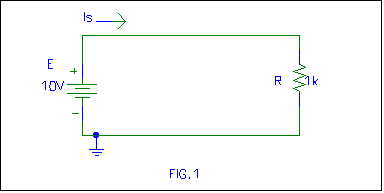
In the circuit from FIG.1, determine current flowing through resistor R and the power dissipated by that resistor.
As you can see in the schematic, the circuit has a voltage source (E), with a value of 10V, and a resistor (R) connected to it. We labeled the current provided by the source with Is, and as you can see, that current exits the positive of the voltage source, and flows through the resistor. According to Ohm's law, that current will be equal to:
Now that we know the current flowing through the resistor and the voltage across the resistor, voltage that is equal to the voltage of the source, we can determine the power dissipated by the resistor:
The short analysis of the circuit from FIG.1 has been completed. Are you ready to go ahead and start the analysis of more complicated circuits? First let's learn more useful things, in the lectures that follow.