Illustrations
Example: The Cardiac Cycle
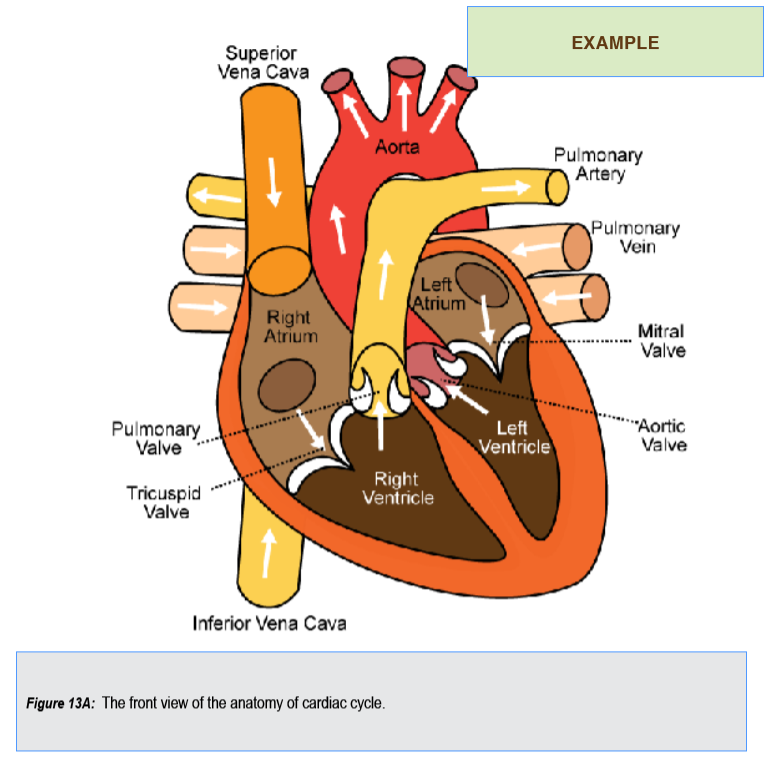
Figure: Front view of the heart showing blood flow through the cardiac cycle.
Guidelines for Describing Illustrations
Describe processes
For diagrams or illustrations with arrows, describe the arrow’s function instead of the arrow itself. Use appropriate phrases, such as “leads to,” “points to,” “yields,” “feeds on,” “changes into,” depending on the context.
Combine with other alternatives
Use bulleted lists to organize the steps when individual phases are important.
Generalize for clarity
Use a narrative to tell a story when the general concept is more important.
Alternative Format Options
Text description tells the story of the process.
This diagram illustrates the anatomy of the cardiac cycle. It shows a cross-section of the heart. Blood enters the heart through the inferior and superior vena cava, emptying oxygen-depleted blood from the body into the right atrium. The blood then travels to the right ventricle and is pumped to the lungs via the pulmonary artery. The pulmonary vein empties oxygen-rich blood from the lungs into the left atrium. This blood is then pumped to the left ventricle and is sent to the systemic circuit via the aorta.
Text descriptions and lists can be used together. Use descriptions to summarize the general concept and use lists for information in more detail.
- In contraction (systole), the heart pumps blood out through the arteries.
- In relaxation (diastole), the heart fills with blood. One complete sequence of filling and pumping blood is called a cardiac cycle.
- Pressure in the atria exceeds ventricular pressure. The AV valves open and the ventricles fill passively.
- Atrial contraction forces additional blood into ventricles.
- Ventricular contraction pushes the AV valves closed and increases pressure inside the ventricle.
- Increased ventricular pressure forces the semilunar valves open.
- As the ventricles relax, pressure in the arteries exceeds ventricular pressure, closing the semilunar valves.
Common Mistakes to Avoid
- Describing arrows instead of movement — Say “blood flows to the lungs” not “an arrow points upward”
- Losing the sequence — Processes have order; maintain it in your description
- Omitting the purpose — Explain what the process accomplishes, not just what happens
Where to Place the Description
Give the description a heading and reference it in the alt text, or otherwise make sure the relationship between the description and image is clear. If the description is placed at the end of the document use #heading reference links to move back and forth.