Diagrams
Example: Human Brain Anatomy
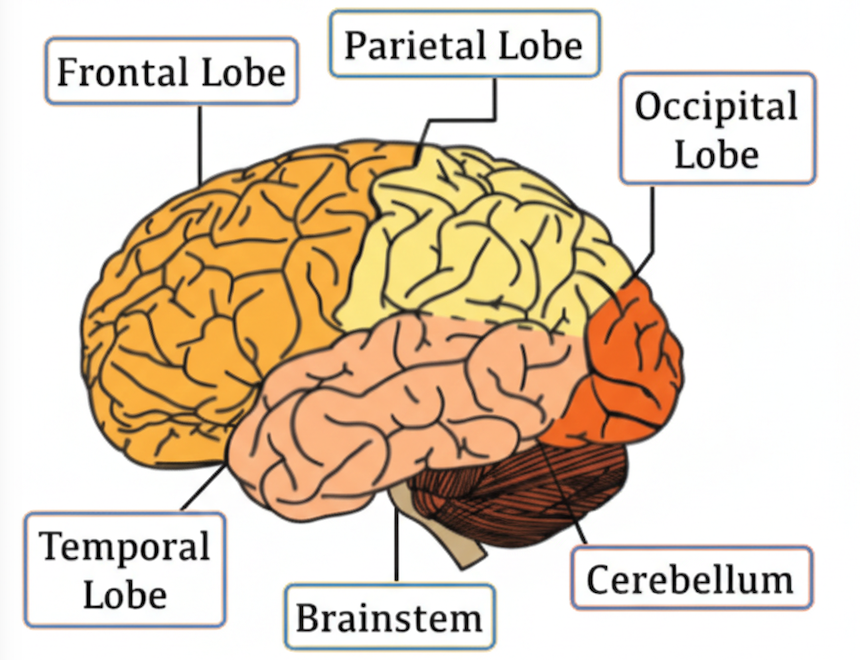
Figure: Side view of human brain anatomy showing the six major regions.
Guidelines for Describing Diagrams
Identify the type of image
i.e. graph, diagram, chart, schematic
Determine the main point of the image
What is the image about?
Describe systematically
- Give a brief overview, move from general to specific
- Organize the description moving left to right or top to bottom
Use Lists, Sub-Headings or Paragraphs to break up information for navigation
Long paragraphs have to be started from the begining or navigated word for word. Items in a list and headings can be navigated to.
Alternative Format Options
Narrative description provides context and relationships.
The diagram shows the anatomy of a human brain. It is divided into six major sections. Starting from the upper left and moving clockwise is the Frontal Lobe, Parietal Lobe, Occipital Lobe, Cerebellum, Brainstem, and Temporal Lobe. (1) Frontal Lobe takes about half of the brain. (2) Parietal Lobe is in the middle between Frontal Lobe and Occipital Lobe. (3) Occipital Lobe is a small part at the back of the brain. (4) Cerebellum is the same size as Occipital Lobe and located below it. (5) To the left of Cerebellum is the Brainstem, a tip that connects to Temporal Lobe. (6) Lastly, Temporal Lobe is the left part of the brain.
Labeled lists work well for identifying parts and their locations.
From the top left of the image moving clockwise, the human brain consists of:
- Frontal Lobe - located in the front of the brain
- Parietal Lobe - located near the center of the brain behind the frontal lobe
- Occipital Lobe - located in the back area of the brain
- Cerebellum - located behind the top part of the brain stem (where the spinal cord meets the brain) and is made of two hemispheres (halves)
- Brainstem - connects the cerebrum with the spinal cord
- Temporal Lobe - located beneath the frontal and parietal lobes & centered across both cerebral hemispheres of the brain
Common Mistakes to Avoid
- Using only visual references — “The pink area” is meaningless without sight
- Omitting spatial relationships — Parts exist in relation to each other; describe those connections
Where to Place the Description
Give the description a heading and reference it in the alt text, or otherwise make sure the relationship between the description and image is clear. If the description is placed at the end of the document use #heading reference links to move back and forth.